Wednesday, 25 March 2015

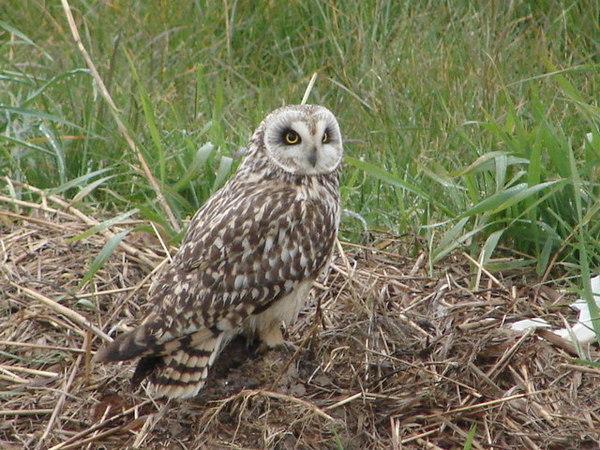
Short-eared Owls love Field Voles!

Short_Eared_Owl_-_geograph.org.uk_-_771750.jpg   
Short-eared Owl - Ian Paterson [CC BY-SA 2.0 (http://creativecommons.org/licenses/by-sa/2.0)], via Wikimedia Commons

Short-eared Owls seem to be regular winter visitors to the Ridgeway in West Berkshire and so I decided to take a short trip to see them. Arriving an hour or so before sunset, it didn't take long to see several hunting along the long grass and scrub. They perched frequently on the fences and posts, so I thought I would check to see if there were any pellets. I did in fact find one, but later lost it!

At the recent Berkshire Mammal Group AGM and very interesting talk from PC Ian Whitlock on Wildlife Crime, I saw there were copies of the FSC/HOT Guide to British owls and owl pellets available and thinking I'd later try pellet dissection, I bought one.
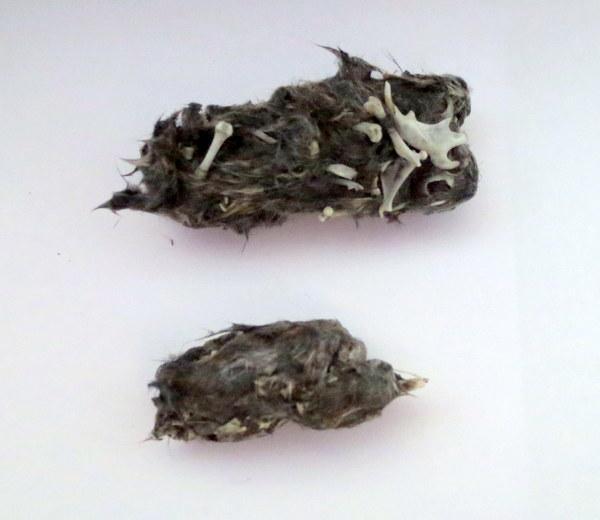
SEO pellets.jpg
Short-eared Owl pellets

Another trip to the Ridgeway one lunchtime produced 7 pellets in a short time. They were fairly easy to find under the wooden fences and near marker posts, though there were not huge piles in any one place. I already knew these were Short-eared owl pellets from the location and they were smooth and grey exactly as described in the guide. They were also light, containing lots of fur.

Although I suspected that most of the prey would be rodents, I wasn't sure which bones I'd find in the pellets. I realised that as the owls swallow small mammals whole, all the parts of the prey that are not digested (fur and bones) must be regurgitated at some point.

Soaking the pellets in water with a little disinfectant loosened them up. It was surprising that despite being light, they are highly compact and takes a little time with the tweezers to separate out the bones. Another slight surprise was the appearance of the leg bones. They were small but sturdy looking with clear ball and knee joints. The human resemblance made me feel sympathy for the prey.
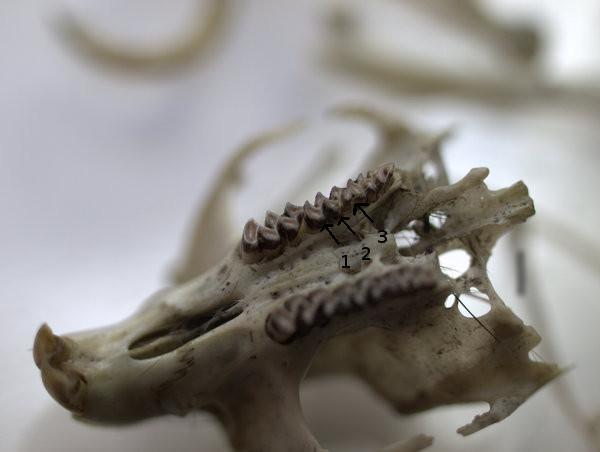
    FVole upper teeth2.jpg
Field vole upper teeth - zig-zag with 3 lobes on inner middle tooth

The first pellet contained not one, but at least two prey items. The lower jaw molars showed that these were voles, but closer inspection was needed to decide between Field vole and Bank vole. Fortunately, I had a magnifying lamp, and a macro lens for the camera and this was not too difficult. There are three molars on each side. They form a sharp zig-zag with three lobes on the inner part of the middle tooth. This makes this a skull from a Field vole. The second (larger) pellet contained no less than 4 Field vole skulls!

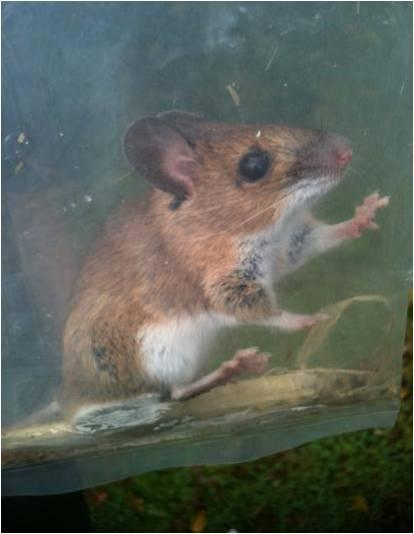
One pellet contained some remains of a Wood mouse as well as a Field vole. The lower jaw of the Wood mouse is a different shape to that of the Field vole, and on removing the teeth, you can see 6 root holes.
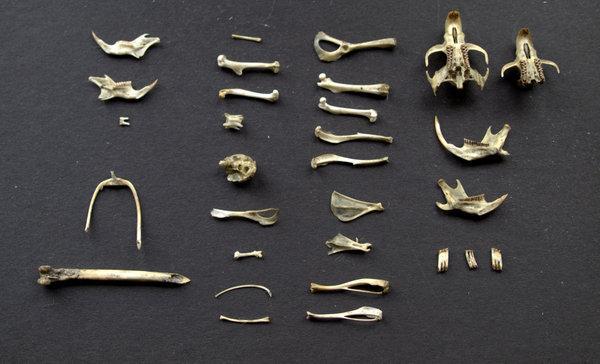
All bones.jpg

Wood mouse jaws (top left), bird wishbone and leg-bone (bottom left), Field vole bones (right 3 columns)
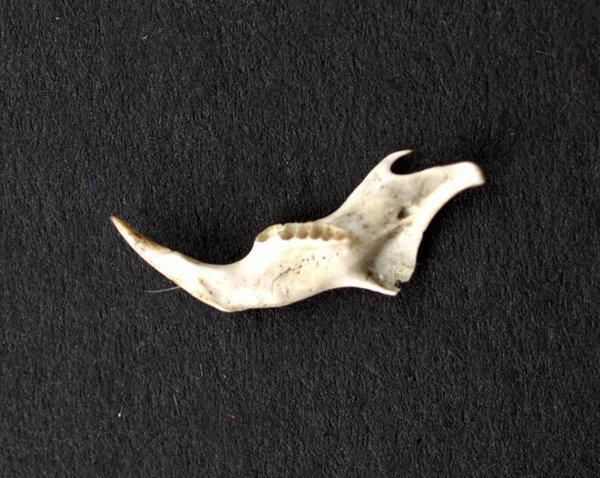
    WMouse ljaw.jpg
Wood mouse lower jaw with 6 root holes

A further pellet contained remains of a medium-sized bird. I won't try to guess the species, but I suspect it was at least as big as a thrush. This pellet was far more unpleasantly “mushy” - perhaps feathers break down in the owl's gizzard unlike mammal fur?.

Overall, in the 7 pellets there were at least 11 Field voles, 1 Wood mouse and 1 bird. There was quite some size variation in the Field vole bones, as well as in their teeth.

The habitat from which I collected the pellets was rough grassland with scrub but few trees, so perhaps this is no surprise. This is also consistent with published papers of Short-eared Owl diet; Field voles forming the vast majority of Short-eared owl prey, with Wood mice, Rats and various birds making up most of the rest.

If you are lucky enough to see a Short-eared owl hunting, it's a fair bet that there are plenty of Field voles around!

Rob Davies

Tuesday, 3 March 2015

March 2015 Mammal of the Month - The Brown Hare


Our mammal of the month for March, is the 'Mad March' hare. Brown hares are present across most of the country in lowland areas and our records for Berkshire are all in the west of the county to date (west of Bradfield) so it would be great to get some from elsewhere - see if you can spot this speedy character when walking on farm or grassland. Please record any sightings for us here.


Our top five hare facts are:


* They can run fast - up to 45 miles per hour!


* They have longer ears than rabbits, with black tips


* Unlike rabbits, they don't burrow. Instead they make small depressions called forms.


* Young hares are called leverets


* Females can have up to four litters every year.


The Mammal Society factsheet has more details:

Tuesday, 24 February 2015

Tracking the Fox

Photo Credit: Becky Thomas
It had been a mild winter – no sledging and snowmen before Christmas as we had in 2010 and 11 – but at the end of January came what the media called “the Beast from the East”. Cold air swept in from the Continent, chivvying flocks of redwings before it, and hail pelted down in a furious, but mercifully brief burst on the 29th. Then on Saturday 31st, I awoke to find the landscape covered in a velvety coating of snow. It wasn’t yet 7.00 in the morning, so the scene looked calm and peaceful in the lamplight; there was only one set of tyre tracks in the road out front. I thought I’d go for a walk in the first snow of the year and enjoy the frozen serenity of Maiden Erlegh Nature Reserve before anyone else was up.


Wrapped up in hat, scarf and gloves I set out, my Wellingtons pressing on the virgin snow. Only it wasn’t virgin – someone, or something, had been here before. There was a set of paw prints stretching down the pavement towards the lake. Instinctively I followed them, wondering what they were: cat? (wrong shape); dog? (too big) – surely fox! They crossed the road and proscribed a circle on a neighbour’s lawn, then on to the grass in Lakeside and along the path. Approaching the gate I saw them divert across the sward and out onto the road. One set of tracks led out to the houses in Lakeside, and another came back. I followed them along the path to the weir and the foot of the lake. They diverged: one into the woods, and the other on to the fishing platform. They were definitely fox tracks, dainty, forward facing and – vitally – unaccompanied. Prints were to be found on the path leading to the playground, and though I lost sight of them in Laurel park and around the pavilion, I found them again passing the Interpretation Centre and onto Instow Road. This was too easy, the fox was following one of the routes I take of an evening! The trail went cold in the meadow – disappointingly, as that is where a den can usually be found in the summer – but was picked up again as I rounded the sediment pond at the Beech Lane end. The tracks crossed the road and along the footpath for a while, before cutting through a gap and up Allendale Road.


"Caminozorro" by Erfil - Own work. Licensed under CC BY-SA 3.0 via Wikimedia Commons - http://commons.wikimedia.org/wiki/File:Caminozorro.JPG#mediaviewer/File:Caminozorro.JPG
One, or possibly two foxes between them had taken the same circuit as I often do, before daybreak prompted them to seek cover. But then I’ve also seen them on summer evenings in the past, openly trotting along the paths a dusk. But now, when sightings of foxes are rare (compared with a couple of years ago), these tracks came as a pleasing reassurance of their continuing presence.

Edwin A.R. Trout

Sunday, 8 February 2015

Dormouse Box Check and Clean

Moor Copse Dormouse Box: Check and Clean – 18th and 24th January 2015

Damian Carter (BMG Treasurer)


It was time for the dormouse boxes at Moor Copse nature reserve to be checked, cleaned and, in some cases, simply located. This being the first time I’d ever done this properly, I was expecting a pleasant walk through the nature reserve, clean out a few boxes and then wander home after a good bit of fresh air. Well I was mostly right.
 

The small group of us set out with bags of spare boxes, wire, cutters, “stuffers” Amanda provided us with, a couple of ‘outdoor’ marker pens and Liz with a map marking where all the boxes where. The idea being simply to clean out the boxes, while the dormice are hibernating at ground level, re-mark the fading numbers and replace any that were broken, or missing, and remount any that needed it.

 
Wandering through a wood looking for wood-en boxes, even with a marked up map, isn’t quite as easy as it sounds, especially when you have to remember to look behind you sometimes to see the ones that you’ve just walked right past! Sharp eyes and a good sense of direction come in very handy.


So, approaching the first box I find out what the “stuffers” are for: sticking in the hole to stop any residents from escaping before we’ve had a chance to properly read them their rights and evict them! After all these are dormice boxes, not wood mice, yellow-necked mice or pygmy shrew boxes, but I guess they can read the signs!

Yellow-necked Mouse


I was actually quite surprised at just how many of the boxes were in fact occupied. We took pity on the couple of wood mice families we found which still had large numbers of young in residence.


Pygmy Shrew

Wood Mouse

We had a complete range of box contents from old mice’ nests, filled with chewed nuts; birds’ nests; an incredibly tough, sticky and elastic hive-like nest (jury still out on what these were, caterpillar, bees nest?); through to completely empty – not even a leaf!


I managed to get a few photos but sadly, like so many others, my camera skills need improving so many came out complete blurs but here’s a few of the others. If anyone can identify what creature was responsible for the droppings in one of these it’d be interesting to know.

Friday, 6 February 2015

Berkshire Mammals Group AGM and Wildlife Crime Talk

NEXT INDOOR MEETING and AGM

Our next indoor meeting is the Annual General Meeting at 7pm on Thursday 26th February followed by a talk given by PC Ian Whitlock who will speak to us about his work as a Wildlife Crime Officer.

Ian has been a Wildlife Crime Office for over two years and specialises in CITES (the Convention on International Trade in Endangered Species of Wild Fauna and Flora) and exotic animals.  He has run a number of investigations including taxidermy cases, bat roosts and puppy farming, and securing the first ever CITES prosecution for Thames Valley Police.  He aims to provide an overview of wildlife crime and the work in which he is involved, with examples drawn from experience and emphasizing mammal cases.

Talks are £4 for non-members and free to BMG members (why not join on the night? see Membership for more details). The University of Reading is kindly sponsoring this event by providing a venue and free admission to any current University of Reading students.

 The talk will be held in Room G74 in the Philip Lyle Building (near the Harris Garden) on Whiteknights Campus, University of Reading. The 20 and 21 buses both serve the Pepper Lane bus stop just outside the campus entrance (the stop after the main university one if coming from Reading town centre). Free parking is available in front of the adjacent Harborne Building in Car Park 13. Please use the Pepper Lane entrance to the university, turn right at the roundabout and then follow the road around until you reach the building, which will be on your right. For further details please consult the campus map, available here.

 The door to the building will be locked from 7pm onwards, so please try to arrive in good time (anyone arriving after 7pm will have to call a mobile number left on the door to be let in).

 As part of the AGM we will vote in the committee positions for another year. We currently have two vacant positions:

 1) Surveys Officer: To co-ordinate and organise species surveys and to maintain records submitted to the group

 2) Secretary: To take minutes during committee meetings and to oversee the general emails

If you are interested in either of these positions, then please get in touch at berksmammals@gmail.com

Sunday, 1 February 2015

February 2015 Mammal of the Month - The Wood mouse


February's mammal of the month is a bit easier to spot than January's otter. This month's star is the Wood mouse. 

This is the mouse you're most likely to see in most parts of Berkshire, including urban areas, and by far the most common species that we find in our live trapping surveys. Please record any sightings via the BMG records page  - we really appreciate all of your records and don't forget, it's not just sightings of the mammal of the month that we're after but any sightings or signs of any wild mammal.
Photo Credit: Becky Thomas
Our top facts for the wood mouse are:
  1. They can be easily distinguished from field and bank voles by the size of their ears - as you can see from the photo they are rather large. Those of voles are hardly visible in comparison. Check out the Mammal Society info here for other species that they could be confused with and how to tell them apart.
  2. They are prolific breeders! The usual season is March to October but can be all year round if there is enough food. Females are able to get pregnant again very soon after each litter.
  3. They store food in caches in underground burrows
  4. They nest together in groups over the winter
  5. They are an important source of food for many other species - anything from foxes to owls (and of course pet cats!) will eat them.

Monday, 5 January 2015

Busy Times for Berks Dormice


Photo
©Rob Strachan WildCRU


Happy New Year Everyone!!


The dormouse is a small, nocturnal mammal weighing in at 30g. For a large part of the year (6 months or more), they hibernate in nests on or under the ground. Dormice spend most of their active time high off the ground in tree canopies and not just in hazel woods, they have been found in pine-dominated commercial forests and in people’s greenhouses and allotments!

Dormouse numbers are estimated to have halved in the last 100 years, with the majority of remaining populations occurring in southern England. The main reasons for this decline appear to be linked to the loss and fragmentation of ancient woodlands, reduction in woodland management practices and, more recently, climate change. Berkshire is just on the edge of this range with what appears to be a correlated lowering of numbers.
My name is Amanda Lloyd, I am a mammal ecologist and will be leading and organising the dormouse surveys in the coming months. Currently we have 4 sites with dormouse boxes in place, one site was checked in November for dormice and 3 nests were found in the boxes, which is great news and I am looking forward to finding the actual animal (maybe more than one!) in question in spring. 
 
This year the dormouse surveys (as part of the National DormouseMonitoring Programme) will truly commence but first we need to ascertain the state the boxes are in and repair any old un-useable ones. Thanks to membership fees we have been able to purchase 50 new shiny boxes that will be used to replace any old and worn-out boxes.

 Some of our new boxes


Photo: Amanda Lloyd

So as you can see busy times ahead and any help whether that be in the form of providing dormouse sightings or actively volunteering your time with box checks or “nut-hunts” is all appreciated and a nice way to spend a day out in the countryside! If you do want to get involved please email: dormice.bmg@gmail.com
 
Photo
©Rob Strachan WildCRU